

Open any bathroom cabinet in India, and there’s a chance you’ll find coconut oil in it. It’s been there for generations – pressed on scalps by mothers and grandmothers long before hair care became an industry.
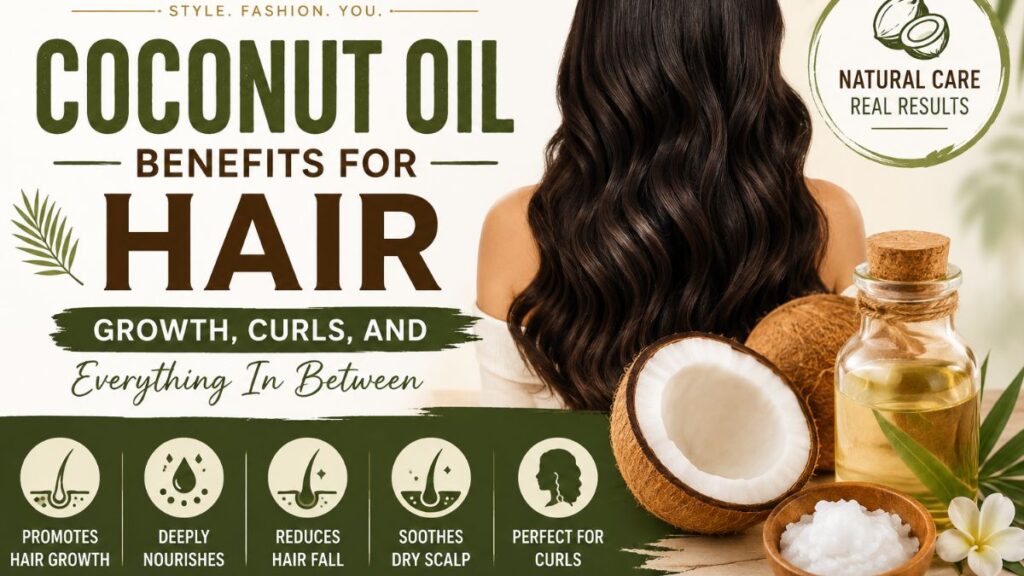
But what are the coconut oil benefits for hair? And is it right for your hair specifically?
Here’s a straight answer to every coconut oil question worth asking.
Why Coconut Oil Benefits for Hair Work Better Than Other Oils
Most hair oils like argan, almond, castor, etc., sit on the surface of the hair shaft. They coat, they shine, they temporarily smooth, but they don’t actually enter the strand.
Coconut oil’s main fatty acid is lauric acid. It has a low molecular weight and a linear carbon chain, which together allow it to physically enter the hair shaft rather than just sit on top. That penetration is why coconut oil benefits for hair go beyond surface-level conditioning. It works from inside the strand, not just on top of it.
This is the structural reason coconut oil earns its reputation, while most other oils remain cosmetic fixes.
Coconut Oil Benefits for Hair – What It Actually Does
Reduces Protein Loss in Hair (Prevents Breakage)
Hair loses protein during washing, brushing, and heat styling – a process called hygral fatigue. Research published in the Journal of Cosmetic Science found that coconut oil, applied before or after washing, significantly reduces protein loss compared to mineral oil or sunflower oil.
For hair that breaks easily, feels thin, or snaps during combing, this is the most important coconut oil benefit for hair to understand.
Improves Moisture Retention Without Heavy Build-Up
Unlike heavy silicones that can block moisture absorption over time, coconut oil moisturises while still allowing the hair shaft to breathe. That makes it better suited for dry, brittle, or chemically treated hair.
Coconut Oil for Dry Scalp: Soothing Flakes and Irritation
Coconut oil has well-documented antimicrobial and anti-inflammatory properties. On a flaky, itchy, or inflamed scalp, it reduces irritation without the drying effect that medicated anti-dandruff shampoos often leave behind. Massaging a small amount into the scalp 30 minutes before washing is enough to make a difference over a few weeks of consistent use.
Will Coconut Oil Help Hair Grow? What It Actually Does for Hair Growth
Will coconut oil help hair grow? This is probably the most searched hair question tied to coconut oil, and the honest answer is: indirectly, yes.
Coconut oil doesn’t stimulate hair follicles the way minoxidil or rosemary oil does. But it creates the conditions that allow existing hair to grow longer without breaking. Reduced protein loss means strands survive longer before snapping. A healthier scalp means follicles aren’t working against inflammation or blocked pores.
Does coconut hair oil help hair growth in a direct, follicle-stimulating sense? Current research doesn’t confirm that. But length retention is where coconut oil genuinely delivers. It helps your hair stay longer. Most people aren’t struggling to grow hair; they’re struggling to retain the length they’re growing because strands are breaking before they get there. Reduced protein loss and better scalp health mean strands survive longer before snapping off.
So, does coconut hair oil help hair growth in a length-retention sense? Genuinely yes.
Is Coconut Oil Good for Curly Hair?
Coconut oil and curly hair have a complicated relationship – and it comes down to hair porosity.
Is coconut oil good for curly hair with high porosity? Generally yes. High porosity hair has gaps and raised cuticles that lose moisture fast. Coconut oil slows that loss, reduces protein damage, and helps curls stay defined longer between washes.
Low porosity curly hair is different. Low porosity hair has a very flat, tightly closed cuticle. Coconut oil can’t penetrate easily, so instead of absorbing, it sits on top and builds up. The result is curls that feel heavy, greasy, and limp a day after washing. If that’s your experience, the oil isn’t the problem – the application method is.
The fix: apply coconut oil to damp hair (open cuticles absorb better), use smaller amounts, and rinse thoroughly rather than leaving it overnight.
Black Coconut Oil for Hair: Benefits, Ingredients, and How It Works
Black coconut oil for hair is traditionally made by slow-cooking coconut milk or grated coconut with herbs (most commonly amla, bhringraj, curry leaves, or hibiscus) until the mixture darkens and the oil separates. The dark colour comes entirely from the botanicals, not any additives.
It’s been used in South Indian and Sri Lankan households as a weekly scalp treatment for generations. The base benefits of coconut oil are all present, plus whatever the added herbs bring. Amla adds vitamin C and supports scalp circulation. Bhringraj has a traditional use for reducing hair fall. Curry leaves are loaded with antioxidants.
Is it better than plain virgin coconut oil? For scalp health and hair fall specifically, the herbal additions genuinely add something. For protein loss reduction and moisture retention, plain coconut oil performs the same function.
How to Use Coconut Shampoo and Conditioner With Coconut Oil Treatments?
Using coconut shampoo and conditioner alongside an oil treatment creates a layered approach that covers both deep conditioning and daily maintenance.
The most effective routine: apply coconut oil as a pre-wash treatment 30–60 minutes before shampooing. This protects the hair shaft during washing – when hair is most vulnerable to protein loss – and the coconut shampoo and conditioner step then cleanses and lightly conditions without stripping everything the oil just delivered.
For very dry or damaged hair, an overnight oil treatment once weekly, followed by a coconut-based wash routine, works better than daily oiling on dry hair.
FAQs – Coconut Oil Benefits for Hair
Reduced protein loss during washing, improved moisture retention, scalp inflammation relief, and length retention over time. These benefits are backed by research, specifically around lauric acid’s ability to penetrate the hair shaft rather than just coat it.
Not in the follicle-stimulating sense. Does coconut hair oil help hair growth is better answered as: it helps retain the length you’re already growing by reducing breakage and maintaining scalp health. It’s a retention tool, not a growth trigger.
It depends on porosity. High porosity curly hair typically responds well. Low porosity curly hair can experience buildup and limpness. Apply to damp hair in small amounts and adjust based on how your curls respond after washing out.
Black coconut oil for hair is traditionally made by slow-cooking coconut with herbs like amla or Bhringraj. It carries the base benefits of coconut oil plus the properties of added botanicals. Whether it outperforms pure virgin coconut oil depends on the specific herbs used and hair type.
Once or twice weekly, as a pre-wash treatment, works for most hair types. Daily application without washing tends to cause buildup, particularly for fine or low-porosity hair.
Both serve different purposes. Coconut shampoo and conditioner maintain daily hydration and cleanse gently. Coconut oil treatments deliver deeper conditioning that a rinse-off product can’t replicate. Used together as a routine, they complement rather than replace each other.