

A styling guide written the way a friend in fashion would actually talk to you
What Does Indo-Western Dress Meaning Actually Stand For?
Indo-Western dress meaning is purposely joining Indian fabrics, prints, or drapes with the styles or silhouettes of Western culture, for example, a silk skirt matched with a fitted shirt or a draped saree styled with a structured jacket. It is neither a costume nor a compromise. It is a way of dressing that enables you to introduce your culture in the places where things move at the pace of the West: boardrooms, brunches, sangeets, and everything in between.
The Morning Your Wardrobe Stopped Making Sense
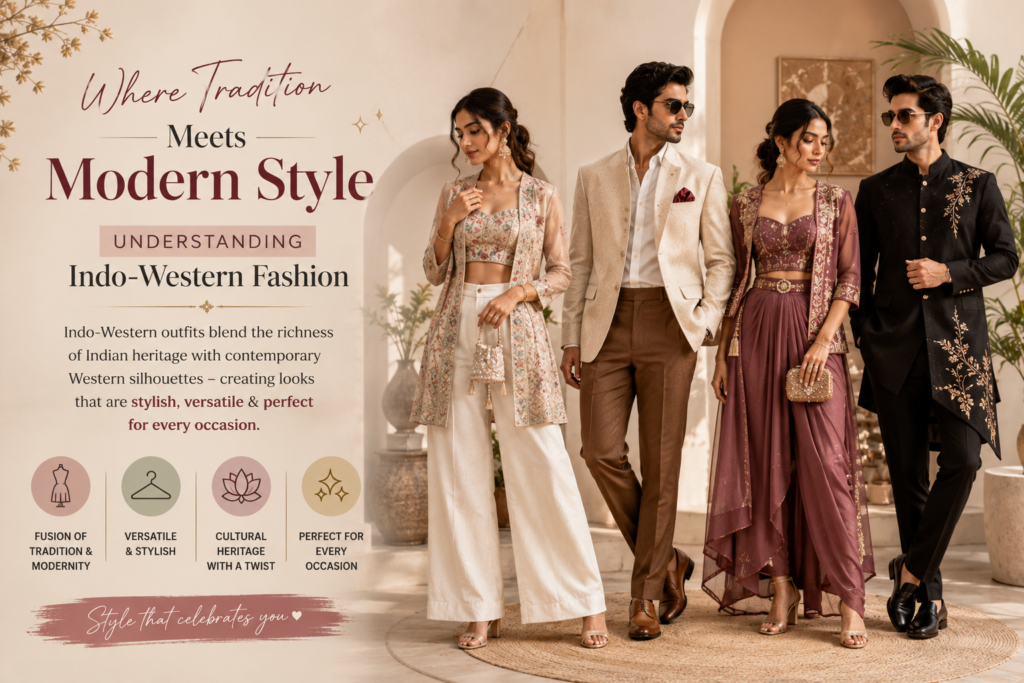
Picture this. You are standing in front of your closet at 7:40 in the morning. On one side hangs your grandmother’s silk, heavy with memory and zari thread. On the other hangs the crisp white shirt you wear to client calls. You need both lives today — the wedding lunch at noon, the work call at three — and neither side of that closet seems to have an answer for you. Many modern fusion styling trends seen on Vogue India and Pinterest have influenced today’s Indo-Western fashion.
If that moment feels familiar, you are not alone, and you are not doing anything wrong. You are simply standing at the exact crossroads where Indo-Western outfit ideas were born.The Indo-Western dress meaning has evolved with changing fashion trends. This is not a trend that fashion magazines invented in a vacuum — it is the practical answer to a question millions of people like you ask every single day: how do I wear who I am without changing clothes three times before lunch?
This guide walks with you through that closet, room by room, occasion by occasion. You will not find vague styling commandments here. You will find the specific combinations — skirts with shirts, crop tops with lehengas, sarees with blazers — that real stylists reach for when real people ask them exactly what you are asking right now. Wherever you are in your own styling story, there is a place for you to step in.
So What Is the True Indo-Western Dress Meaning, Really?
Strip away the jargon, and you are left with something simple: Indo-Western dress meaning describes any outfit where Indian textile traditions meet Western tailoring. It is your silk dupatta draped over a structured blazer. It is your mother’s old Banarasi skirt, reborn under a crop top for your cousin’s sangeet. The movement exists because real wardrobes, real budgets, and real schedules demanded it — not because a runway decided it should.
You will notice this style of language showing up everywhere once you start looking for it — at destination weddings, in office dress codes that have quietly loosened over the years, in the closets of women who travel between cities and cultures in the same week. A few things tend to hold true wherever you find it:
- Your tailoring does the heavy lifting. A well-cut shoulder or waistline turns even simple fabric into a finished look.
- Breathable fabric is non-negotiable. Georgette, linen, and cotton let you move through a 10-hour wedding without wilting.
- Reuse is built in. Your grandmother’s saree or your own old lehenga skirt is not retired — it is reinterpreted.
- Comfort and confidence are the actual goal, not just the visual.
The Tuesday Test: Can Heritage Survive Your Actual Week?
Here is a fair question you might be silently asking: Does this only work for weddings, or can it survive a Tuesday? The honest answer is that some of the best Indo-Western outfit ideas were never designed for festive calendars at all — they were designed for exactly the week you are living right now.
Think about the block-printed cotton kurta that has been sitting in your cupboard since last Diwali. Pair it with the blue denim you already wear three days a week, and you have a look that costs you nothing new and says everything about you. Or take the chikankari dupatta you inherited — laid over a tailored blazer, it turns a routine Monday meeting into something memorable, without ever feeling like you tried too hard.
- Block-printed cotton kurtas with classic blue denim — your easiest weekday win.
- Chikankari embroidery layered under a structured blazer — for the meeting where you want quiet authority.
- Breathable linen trousers under a handwoven, asymmetric short tunic — for the day you are on your feet from morning to night.
- An old handloom saree, upcycled into a tailored jacket — proof that nothing in your closet has to retire.
None of this asks you to spend more. It asks you to look again at what you already own, and that, more than any trend report, is what makes this approach trustworthy enough to actually live by.
Finding the Fit That Was Always Meant for You
Somewhere along the way, you were probably told that ethnic wear comes in one shape, and you were expected to fold yourself into it. Forget that. The entire premise of fusion dressing is that the silhouette adjusts to you not the other way round.
If you carry weight at the hip, wide-legged palazzos under a fitted crop top will give you a clean, balanced line. If you want height and drama, a structured blazer thrown over a flowing asymmetrical kurta pulls the eye upward and lengthens you instantly. A leather belt cinched over a loose, draped piece can turn shapeless fabric into a defined waist in seconds, and tailored trousers paired with a peplum top will carve out an hourglass even on days you feel anything but.
- Wide palazzos with a fitted crop top — for a balanced, grounded line.
- A structured blazer over an asymmetrical kurta — for vertical drama.
- A leather belt over loose drapes — for an instant, no-effort waistline.
- Tailored trousers with a peplum top — for a classic hourglass silhouette.
This is the quiet expertise good stylists rely on not rules about what you should hide, but structure that lets your actual body wear the clothes with ease.
The Wedding Invitation Just Arrived — Now What?
You know the feeling. The invitation lands in your inbox, the excitement lasts about four minutes, and then the familiar question creeps in: What on earth am I going to wear? Choosing an Indo-Western dress for female guests at a wedding does not have to be the stressful scavenger hunt it usually turns into, if you walk in with a short checklist instead of a blank panic.
- Choose breathable fabric first — georgette, organza, or cotton will carry you through a 10-hour function without a single complaint.
- Let embroidery sit in one place, not everywhere — placement work on the neckline or hem reads as elegant, not exhausting.
- Check the shoulder line before anything else — a precise shoulder fit holds the whole garment’s shape for you.
- Welcome an asymmetrical hemline — it adds movement exactly where a straight hem would look static in photographs.
Get those four things right, and the rest of the outfit tends to fall into place almost on its own.
The Outfit Every Stylist Reaches for First: Skirt and Shirt
If you ask any stylist for one foolproof combination, most of them will hand you the same answer: a crisp shirt and a voluminous traditional skirt. There is a reason this pairing has earned that reputation — it is the rare outfit that looks deliberate even when you put it together in under ten minutes.
Picture a white linen shirt tucked into a vivid silk skirt, sleeves rolled to the elbow, a chunky oxidised silver necklace doing the rest of the talking. Or imagine a plain formal shirt next to a heavily patterned brocade skirt, letting the print carry the drama while the shirt stays quiet. Either way, you get a skirt and shirt Indo-Western look that reads as effortless, even though every choice in it was intentional.
How to Wear a Shirt with an Indian Skirt (Especially If You Are a Bridesmaid)
If you have ever stood in front of an old lehenga skirt beautiful, expensive, and worn exactly once this section is for you. Learning how to wear a shirt with an Indian skirt is essentially learning how to give that skirt a second, third, and fourth life.
- Knot a crisp cotton shirt at the front to create a cropped silhouette over the skirt.
- Leave the top two buttons open so your heritage jewellery has room to show.
- If the skirt is a box-pleated Banarasi piece, keep the pleats visible they hold the vertical lines that make the whole look feel tailored.
- Try a pastel linen shirt against a bold, contrasting skirt for a fresh, festival-ready color pairing.
This is sustainable styling in its most honest form not a marketing phrase, but you, genuinely getting more wear out of clothes you already love.
When You Want Zero Decisions: Coordinated Sets
Some days, you do not want to make decisions you want to open your suitcase and have the outfit already decided for you. That is exactly the gap that Indo-Western dresses skirt and top sets fill. Because the pieces are designed together, the guesswork is already done before you even unzip the bag.
- A printed silk skirt-and-top set for effortless, flowing elegance.
- A tailored peplum top over a flared skirt for a flattering, structured outline.
- Neutral tones — ivory, champagne — when you want understated luxury instead of loud colour.
- Dangling earrings are the one accessory that finishes the whole set without competing with it.
These sets travel beautifully too pack light, separate the pieces, and you have two outfits doing the work of one suitcase slot.
When You Want Something No One Else Is Wearing
There is a particular kind of confidence that comes from knowing your outfit exists nowhere else in the room. That is the appeal of a custom Indo-Western boutique piece not mass-produced, not duplicated three times over at the same wedding, but cut for your measurements and your story specifically.
- Hand-placed mirror work that catches light differently on every wearer.
- Custom tailoring built around your actual proportions, not a generic size chart.
- Rare prints and colour combinations you genuinely will not see twice in one venue.
If you are attending several weddings this season, here is where creativity earns its keep:
- A heavily embroidered long jacket over sleek silk trousers for a sophisticated, high-fashion entrance.
- A pre-draped saree with a structured corset blouse for an evening look with real edge.
- A pastel-toned draped jumpsuit when you want minimalism without losing festivity.
- Asymmetric kurtas with crisp cigarette pants for an outfit you can actually dance in.
Mehendi, Sangeet, Brunch: The Crop Top and Skirt Moment
Some outfits exist for the camera as much as the room, and the crop top and skirt set is one of them. It photographs the way it feels youthful, energetic, a little bit playful which is exactly why it has become the unofficial uniform of mehendi mornings and sangeet nights.
- A heavily embellished crop top against a solid silk skirt, so the embroidery has room to stand out.
- Hand-painted floral prints for daytime functions that need freshness, not heaviness.
- A sheer georgette cape layered over the crop top for movement that looks stunning mid-dance.
- A statement leather belt at the waist to sharpen the silhouette before the photos start.
The real beauty of this set is its second life wear the top later with trousers, the skirt later with a plain shirt, and one festive purchase quietly becomes three different outfits across three different seasons.
The Look That Says You Run the Room
There is a particular silhouette reserved for the days you need to walk in and be taken seriously not loudly, just unmistakably. That is what happens when a traditional drape meets sharp Western outerwear.
A tailored velvet blazer over a pre-draped georgette saree, for rich texture without extra effort.
- A structured leather jacket over fluid traditional fabric, for an edge that feels modern rather than rebellious for its own sake.
- A sleek metallic belt cinched at the waist to define the shape under the drape.
- Monochromatic tones to keep a layered, complex outfit from looking cluttered.
This combination has quietly become a favourite among women who want their clothing to reflect both where they come from and where they are headed next.
The Gown That Lets You Skip the Heavy Lehenga
At some point, every wedding season, you will face the cocktail night that calls for drama without the physical weight of a full lehenga. This is exactly the gap the modern Indo-Western gown fills — the silhouette grandeur of traditional wear, carried in a single, comfortable, floor-length piece.
- Deep jewel tones like emerald, sapphire, or plum for evening richness.
- 3D floral appliqués and scattered sequin work for texture without heaviness.
- Precise, made-to-measure tailoring so the structure holds exactly where it should.
- Minimalist white gold or diamond jewellery, so the gown’s detailing stays the focus.
Many brides now choose exactly this for their own pre-wedding cocktail evenings — proof that even the bride is looking for comfort alongside grandeur.
Built to Survive the Choreography: Your Sangeet Look
Whoever choreographed your sangeet performance did not think about your outfit, and that is entirely your job now. The look that wins on sangeet night is the one that survives sharp turns, fast footwork, and three hours under stage lighting.
- Energetic colours — fuchsia, neon peach, lemon yellow — that read well even from the back row.
- Wide-legged palazzos that move with you instead of restricting your steps.
- A structured peplum top with flowing sharara trousers for a fresh, modern silhouette.
- Subtle sequin or mirror detailing that catches the stage lights without weighing you down.
Get the comfort right first, and the photographs will take care of themselves.
What the Runway Is Quietly Telling Your Closet
Every major Indo-Western fashion show eventually filters down into the clothes you actually wear — usually months before you even notice the connection. Watching what designers send down the runway is less about admiring a spectacle and more about reading next season’s wardrobe a little early.
- Sheer, embroidered capes layered over simple crop tops for an instant upgrade.
- Bold, unexpected color-blocking that elevates even simple fusion pieces.
- Traditional handloom fabric paired with unexpectedly sporty details.
- Asymmetrical hemlines bring fluid movement into everyday outfits.
You do not need a front-row seat to benefit from any of this — just a willingness to borrow one idea at a time into your own closet.
The Detail Most People Get Wrong: Your Shoes
Here is something most styling advice skips entirely: the outfit is only half the story. What you choose to put on your feet decides whether the shoes on Indo-Western outfit feel intentional or like an afterthought.
Traditional Wear vs. Indo-Western Fusion: Side by Side
If you are still deciding which direction feels right for your own wardrobe, sometimes a direct comparison is more useful than another paragraph of description. Here is how traditional Indian wear and modern Indo-Western fusion actually differ, element by element.
| Design Element | Traditional Indian Wear | Modern Indo-Western Fusion Wear |
| Primary Fabrics | Pure raw silk, heavy Banarasi, Kanjeevaram. | Organza, crepe, georgette, cotton blends. |
| Draping Style | Manual, complex pleating, traditional drapes. | Pre-draped structures, attached styles, belted drapes. |
| Color Palettes | Highly vibrant shades (crimson red, deep gold). | Sophisticated champagne, ivory, soft pastels. |
| Embellishment | Heavy, dense handwork, thick zardozi thread. | Placement embroidery, 3D floral appliqués. |
| Key Silhouettes | Structured lehenga choli, traditional regional sarees. | Asymmetric tunics, dhoti pants, draped jumpsuits. |
| Footwear Pairing | Traditional juttis, heavily embellished flats. | Metallic heels, chic loafers, sleek sneakers. |
Neither column is the better choice — they simply serve different moments in your life, and most wardrobes today genuinely need both.
The Small Mistakes That Quietly Undo a Good Outfit
You have likely felt this before — an outfit that looked perfect on its own, and somehow still didn’t come together once you were wearing it. Usually, the cause is smaller than you think.
- Pairing heavy bridal jewellery with an already busy, patterned garment — let one element carry the drama, not both.
- Skipping proper tailoring — an ill-fitted piece will read as bulky, no matter how good the fabric is.
- Choosing shoes that clash with the line of the outfit instead of completing it.
- Mixing too many bold prints at once — pick one hero print and let everything else stay quiet around it.
Catch these four, and almost any outfit you choose will hold together the way you intended it to.
Frequently Asked Questions
It refers to the deliberate combination of Indian fabrics, prints, or drapes with Western tailoring and silhouettes a style built for comfort and cultural connection at once, not a fixed dress code.
Handcrafted leather juttis and metallic block heels are the most reliable choices — they ground the outfit visually while standing up to long hours of standing, walking, and dancing.
Tuck a tailored white shirt into a silk or brocade skirt, then cinch the waist with a structured belt. Rolling the sleeves and adding one statement piece of jewellery usually finishes the look.
Yes — clean white or embroidered sneakers are now a popular, comfortable choice, especially with coordinated skirt-and-top sets where you’ll be on your feet or dancing for long stretches.
Stick to shirt-style kurtas with tapered cigarette trousers, then finish with leather loafers. Keeping embroidery minimal and tones neutral keeps the look office-appropriate.
A dedicated Indo-Western boutique offering custom tailoring and hand-placed embellishment is your best bet if you want a piece cut to your own measurements rather than a standard size run.
Conclusion: The Closet You Were Trying to Build All Along
Go back, for a moment, to that 7:40 a.m. moment in front of your closet. Nothing about your two wardrobes — heritage and Western — needs to stay divided the way it once did. Every combination in this guide exists because real people, in real wardrobes, asked the same question you started with: how do I wear all of who I am, today, without overthinking it?
The answer was never about choosing a side. It was about letting your grandmother’s silk sit comfortably next to your tailored blazer, your inherited skirt next to your favourite denim, your heritage jewelry next to a pair of sharp loafers. That is the real, lived Indo-Western dress meaning — not a trend you follow, but a wardrobe philosophy you grow into, one outfit at a time. Understanding the Indo-Western dress meaning makes outfit styling easier.
Disclaimer: Styling suggestions in this guide are general in nature and meant for inspiration. Fit, fabric choice, and embellishment preferences vary by body type, climate, and personal comfort — when in doubt, consult a tailor or stylist before a major event.
.