

You’re standing in front of the mirror, the wedding invite propped against the lamp, and the six yards of fabric draped over your bed are staring back at you like a question you haven’t answered yet. You’ve worn sarees before — to your cousin’s reception, to that office Diwali party — but tonight feels different. Tonight you want to walk in and feel tall, sculpted, unstoppable.
Here’s the thing nobody tells you at the store: the saree itself isn’t what makes or breaks your silhouette. It’s everything you do with it — the way you drape it, the fabric you pick, what you wear underneath, even the blouse cut hugging your shoulders. The same six yards can swallow your frame in volume or carve out a long, elegant line, depending entirely on your saree styling choices.
Think of your finished look as resting on three pillars: the shapewear smoothing your base, the draping technique elongating your torso, and the fabric clinging gracefully to your curves. Get those three right, and the rest the jewelry, the heels, the hairstyle just falls into place around them.
Your First Stop: Finding the Saree Material That Makes You Look Slim and Tall
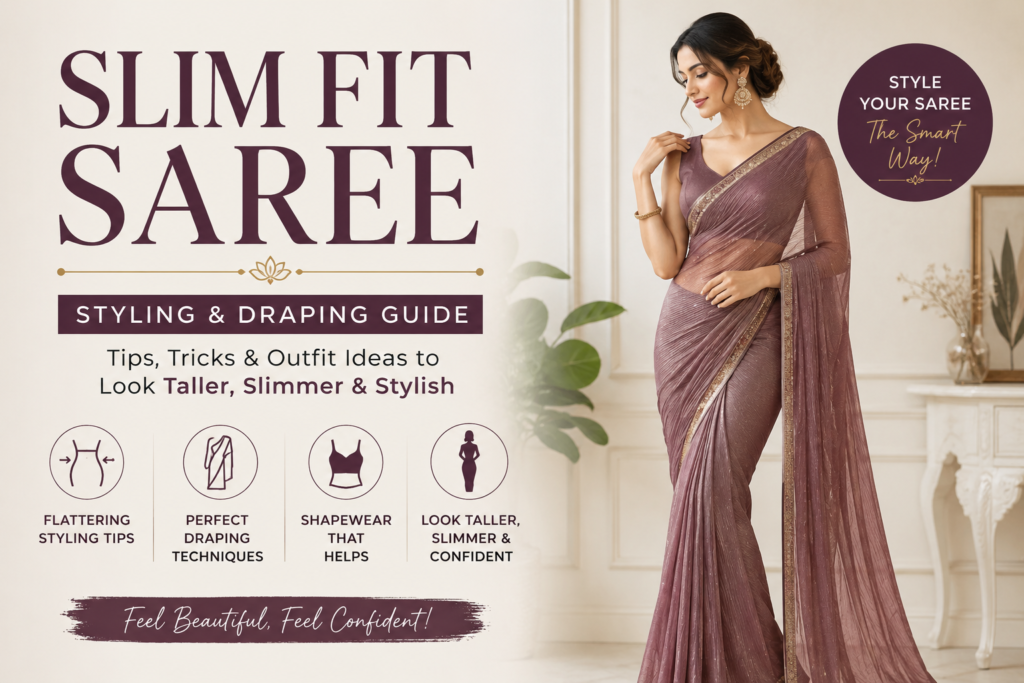
So you head back to the fabric aisle, and this time you touch everything before you buy anything. This is where experience matters more than any size chart ever could: fabric behaves on your body the way it behaves in your hand. Stiff fabric flares outward. Fluid fabric falls close. That’s really the whole secret hiding behind the question of which saree material makes you look slim and tall.
If you’re chasing that slim-and-tall look, lightweight saree materials like Georgette, Chiffon, and Crepe are going to be your closest allies. They’re fluid and body-hugging, and unlike stiffer textiles, they don’t flare outward or add optical bulk at your hips and waistline.
Georgette gives you a soft, bouncy fall that instantly reduces visual bulk. Chiffon is sheer and airy, almost gossamer, so it reads as light even when you’re moving through a crowded hall. Crepe sits somewhere in between crisp enough to hold a clean line, fluid enough to skim your curves without clinging awkwardly. And if you want a touch of shine, Satin glides over your body and creates one continuous vertical line from shoulder to ankle.
None of these is an accidental choice. They’re the same fabrics stylists reach for backstage, minutes before a bride walks out, because there’s no time left to fight a fabric that refuses to cooperate.
When You’re Curating a Plus-Size Wardrobe: The Best Saree for Plus Size You
Maybe your story looks a little different. Maybe you’re not chasing “slim and tall” so much as you’re trying to find the best saree for plus size you that still feels luxurious, never apologetic.
Here’s an honest answer: you don’t need to avoid silk. Organza, Cotton Silk, and Mysore Silk are genuinely stunning, but they’re also starchier, which means they require more precision of your pleating. If you love silk — and you should be allowed to look for lightweight, single-ply versions that fall softly instead of standing away from your frame like a tent.
This is less about which fabric is “allowed” for your body and more about matching a fabric’s natural drape to the silhouette you’re hoping for. A single-ply silk that falls close reads as elegant and intentional. A stiff, heavy weave that stands away will fight you all evening, no matter how perfectly you pleat it. The fabric should work with you, not against you.
Walking Through Your Saree Draping Styles for a Slim Look, Step by Step
Now comes the part where you actually drape. Let’s walk through it together, the way a stylist would talk you through it backstage, one step at a time.
Start with your base. Slip into shapewear made specifically for sarees instead of reaching for the bulky cotton petticoat that’s been sitting in your cupboard since college. It changes everything that follows.
Next, begin tucking your slim fit saree at the navel, letting the lower hem just graze the top of your heels not your flats, your heels because the length only looks right once you’re standing at full height.
When you start your front pleats, make them slightly wider than usual so they lie flat against your stomach instead of bunching up. This single adjustment is what separates an amateur drape from a true flat stomach saree drape, the kind that photographs beautifully from every angle in the room.
Gather those pleats evenly, press them flat with your palm, and tuck them just a touch to the left of your belly button. This is the classic Nivi drape alignment, and it’s far more forgiving than most people expect.
Finally, bring the remaining fabric around your back and over your left shoulder in neat, narrow pleats. That’s your pallu, sorted and secured.
The Real Secret: Saree Draping to Look Thin Lies in Your Pleats
If you take away only one thing from everything you read about sarees, let it be this: the real secret behind saree draping to look thin has almost nothing to do with the fabric and everything to do with pleat geometry.
The most common mistake and you’ve probably made it without realizing is creating too many small, bunched-up pleats directly over your stomach. It feels secure when you tuck it that way, but it adds visible weight right where you don’t want it.
Instead, space your pleats widely and stagger them so the volume spreads evenly across your midsection rather than clustering into a pouch. Then take it one step further: shift your entire pleat bundle about an inch to the left of your navel. That one small shift flattens your front profile and makes your lower torso look longer.
When you get to your pallu, resist the temptation to let it float loose and open. A sleek, pleated drape pinned securely at your shoulder creates two sharp vertical lines down your torso and vertical lines, every single time, read as taller and leaner than horizontal ones ever will.
Your Blouse, Your Frame: How to Look Slim in a Saree Blouse
While you’re still in front of that mirror, it’s worth turning your attention from the saree to the blouse, because your blouse is doing more visual work than you’ve probably given it credit for. It’s the literal frame for your shoulders, neck, and upper torso, and getting it right changes how slim you look in saree blouse photos taken from any angle in the room.
A deep V-neckline is one of the simplest swaps you can make. It elongates your neck and draws attention straight to your collarbones, creating a sharp vertical focal point. If your hips are fuller and you want balance rather than narrowing, a boat neck widens your shoulder line just enough to even out your proportions.
Sleeves matter too. Elbow-length sleeves give you structured, sleek coverage that tones the appearance of your upper arms without ever looking restrictive. And here’s a detail most people skip entirely: match your blouse color to your saree. The moment your blouse breaks into a different shade than your saree, you visually cut your torso in half exactly the opposite of the long, unbroken line you’re going for tonight.
What Happens at Your Back: Saree Blouse Back Designs to Look Thin
You’ll spend the evening with people seeing your back almost as often as your front, so don’t skip this part. Well-tailored saree blouse back designs to look thin usually feature deep, narrow cuts U-shapes, keyholes, plunging rectangular windows that interrupt the broadness of your back instead of letting it read as one flat panel.
Vertical accents help here too: dori ties, sleek piping, even a subtle seam running down the center of your back, all trick the eye into reading your upper body as longer than it is. If your tailor offers it, ask for vertical stripes woven into the blouse fabric itself. It’s a small request, but it elongates your torso in a way that’s nearly impossible to fake any other way.
The Undergarment Revolution: Shapewear for Sarees Changes Everything
Here’s where your story takes its biggest plot twist. Somewhere in your closet is a cotton petticoat with a drawstring you’ve been tightening and loosening for years, and it has quietly been working against every drape you’ve ever attempted.
Switching to shapewear for sarees is the fastest, least glamorous, most effective change you can make this season. Where a traditional petticoat bunches up bulky drawstring layers right at your waistline, modern mermaid-cut shapewear uses a sleek nylon-spandex blend that flattens your abdomen smoothly instead of digging in and creating rolls. Here’s exactly how the two compare, side by side:
| Feature / Detail | Traditional Cotton Petticoat | Modern Mermaid-cut Shapewear |
| Fabric Bulk | High (Bulky drawstring layers) | Low (Sleek nylon-spandex blend) |
| Waist Support | Causes skin digging and rolling | Flattens abdomen smoothly |
| Silhouette Shape | Boxy, straight, or flared | Sculpted mermaid style or fish-cut |
| Mobility & Comfort | Can feel heavy and restrict steps | High stretch with side slits |
That comparison isn’t theoretical — it’s the difference you’ll feel the moment you switch. Mermaid-cut shapewear and fish-cut petticoats hold the heavy weight of your pleats without bunching, which means your slim fit saree glides instead of catching on uneven lines underneath. Your six yards finally get to look the way it was always designed to look.
Choosing Your Palette: Why Dark Color Sarees for Slimming Actually Work
Back at the fabric counter, you’re torn between a soft pastel and a deep emerald, and here’s the honest, slightly unglamorous truth about color theory: dark color sarees for slimming work because deep shades absorb light rather than bounce it back, which minimizes the shadows that usually map your curves for an entire room to see.
Midnight black, rich navy, royal emerald, intense wine red — these aren’t just “safe” choices, they’re strategic ones. To get the full elongating effect, stay monochrome from blouse to saree. The instant your blouse breaks into a contrasting color, you’ve visually split your torso into two shorter halves instead of one long, continuous line.
If you love prints, skip large motifs that spread horizontally across your body, since they widen rather than lengthen. Delicate florals or thin vertical borders do the opposite — pulling the eye downward and making you look taller without you doing anything extra at all.
If You’re Wearing a Net: How to Hide Belly Fat in a Net Saree Without Losing Elegance
Maybe your story this season involves a sheer net saree you fell in love with at first sight, and now you’re wondering how to hide belly fat in a net saree without it looking like you’re hiding at all.
Sheer fabric means your foundation layer has to be flawless, because there’s nowhere left for it to hide. Start with high-waisted shapewear for sarees that sits comfortably above your belly button for smooth, even compression. Then consider a slightly longer blouse: a structured longline or an elegant crop style both work beautifully tucked under a net.
Drape your sheer pallu in neat, compact pleats across your midriff. It adds a stylish, structured layer without smothering the sheerness you fell in love with in the first place. A sleek belt sitting right at your natural waistline finishes the look, cinching the fabric just enough to define your shape.
If You’re the Slim Girl in the Room: Saree Designs for a Slim Girl
And maybe your story is the opposite one entirely. Maybe you’ve spent years hearing styling advice meant for someone trying to look smaller, when what you actually want is dimension, presence, and a little bit of drama.
If that’s you, saree designs for a slim girl look completely different. Organza gives you a voluminous, ethereal flare. Cotton Silk holds structured pleats with a crisp, regal texture. Mysore Silk adds rich, lustrous body to your festive look. Even your pallu becomes a tool here — draping it across your chest as a front pallu adds texture and visual weight exactly where you want it most.
Try a striking front pallu drape or a mermaid-style silhouette to emphasize your hips and shoulders. Bold horizontal patterns, wide borders, and statement embellishments — all the things heavier frames are usually told to avoid — are exactly what create a stunning hourglass illusion on a slimmer frame. The rules really do flip depending on where you’re starting from.
The Final Touches: Accessories, Shoes, and the Walk-In Moment
You’re almost ready to walk out the door, and the last ten minutes matter more than you think. Slip into your heels before you finish draping, not after, because your hemline only sits correctly once you’re at full height — a saree pinned for flats will sit wrong all night once you switch to heels.
For jewelry, go long. Cascading necklaces and drop earrings draw the eye downward in one continuous line. A minimalist metal belt at your waist defines your narrowest point without adding any bulk. And your hair — pull it into a sleek, high bun or a polished ponytail, because every bit of attention you send upward is attention pulled away from anywhere you feel a little less confident tonight.
Every Shape Belongs in This Story
Here’s what every stylist who has spent hours backstage before a wedding will eventually tell you: there’s no single “correct” body for a saree. Six yards of fabric is one of the most forgiving garments ever designed, and it drapes beautifully over every shape the moment the draping, fabric, and undergarments are chosen with intention instead of guesswork.
Use everything you’ve just read as a starting toolkit, not a rulebook. Try the wider pleats. Try the shapewear. Try the monochrome look once, just to see how it feels in the mirror. Keep whatever makes you stand taller, and let the rest go. Then walk into that event with your shoulders back, your pleats sitting exactly where you placed them, and let your own confidence finish the look nothing else could.
Frequently Asked Questions
Which saree material makes you look slim and tall?
Lightweight saree materials like Georgette, Chiffon, and fluid Crepe are your best options. These body-hugging fabrics drape close to your natural frame, eliminating bulk and creating a beautifully slimming silhouette.
How can you make your waist look smaller in a saree?
Swap your traditional cotton petticoat for targeted shapewear for sarees, such as mermaid-cut shapewear. Then space your front pleats widely so they lie completely flat across your midsection instead of bunching.
Do dark colors really help you look slimmer in Indian ethnic wear?
Yes. Dark color sarees for slimming work because deep shades like black, navy, and emerald absorb light. Pairing them with a matching, monochrome blouse creates one continuous vertical line that elongates your frame.
What blouse design makes your arms look more toned?
Elbow-length sleeves give you structured coverage that instantly smooths and tones your upper arms. Pair that with a sharp V-neckline to elongate your neck and pull focus upward.
Can you wear a heavy silk saree without looking overwhelmed if you’re petite?
Absolutely. Opt for a neat, pleated Nivi drape and keep your shoulder pleats narrow and structured, so the fabric showcases your frame instead of overwhelming it.
Disclaimer
The fashion and styling advice in this article is meant as a creative guide to help you enhance your wardrobe. Personal styling preferences vary, and your own comfort with different fabrics, undergarments, and fits may differ from anyone else’s. Fashion trends evolve regularly, and the availability of specific materials or shapewear designs may change over time. Treat these tips as a helpful starting point for discovering what makes you feel most confident and most like yourself.