

The most effective solution for forehead wrinkles depends on which type of lines you have: fine lines, static lines, or ones you make when expressing your face.
For the majority of people, the ideal forehead wrinkle treatment is retinoids, which have been proven by various studies to help improve skin smoothing. Peptides and microcurrent are also useful in supporting a skin care routine; however, if you have deep lines, you will probably need to see a dermatologist for their input.
You’ve probably stood in front of your mirror, tilted your head, and noticed those horizontal lines settling in a little deeper than last year. That’s usually your first real conversation with forehead lines. Before you spend money chasing wrinkles in forehead treatment options online, it helps to understand what’s actually happening underneath your skin.
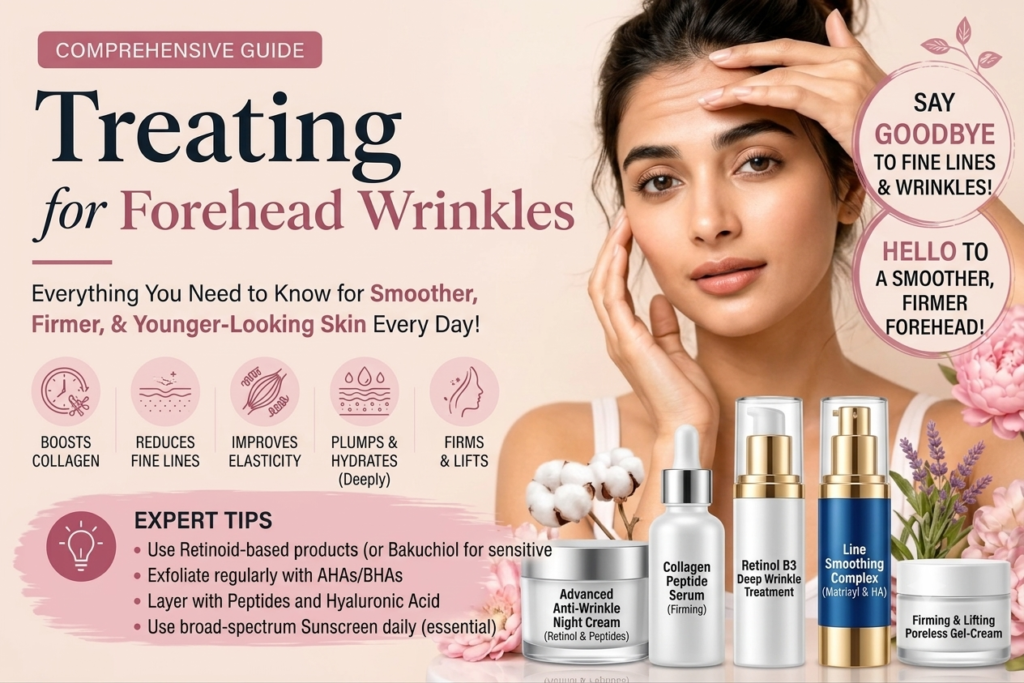
This guide walks you through every realistic forehead creases treatment option, from your bathroom cabinet to the dermatologist’s chair. You’ll learn how to get rid of forehead lines without overpromising results, and where deep forehead wrinkles fit into that picture. No miracle claims here, just what genuinely works.
What’s Actually Causing Those Lines Across Your Forehead?
The first step in treating wrinkles on the forehead is to realize that the reason for such wrinkles is not the remedies. Forehead lines mainly come from three intertwined causes, and understanding which of the sources is the reason for such lines in your case is the key and will completely reshape your approach. It is sort of choosing a shoe by its color without ever checking on the shoe’s size that is the right fit. If you get one, it may work, but it is not certain.
Your Facial Expressions Are Doing More Than You Think
Every time you arch your eyebrows, narrow your eyes, or appear surprised, you’re contracting your frontalis muscle. If you keep this up for decades through countless repetitive movements, you’ll be left with so-called dynamic wrinkles, which appear when you express emotions and vanish when your face is at rest. If you consider a forehead wrinkles procedure, understanding the difference between these two types of lines is essential because the lines that remain visible even when your face is at rest (static wrinkles) will be treated differently.
Collagen Doesn’t Stick Around Forever
Your body usually begins a decline of collagen and elastin around your late twenties or early thirties. Your skin may lose its elasticity, and some wrinkle lines may gradually appear. That is why starting an effective forehead wrinkles treatment regularly as soon as wrinkles start is often a better strategy than beginning it after wrinkles have been deeply etched.
Sun Exposure Speeds Everything Up
Photoaging isn’t a myth that you can ignore. Sunlight with UV rays degrades your skin collagen quicker than the process of natural skin ageing. That’s why our skin doctors continually give the same advice: put on your broad-spectrum daily sunscreen morning after morning, even on the days when the skies are gray. Omit this habit and even the most effective forehead wrinkle treatment will be like pushing a boulder uphill.
So What Is the Best Treatment for Forehead Wrinkles?
Here’s the honest answer: there isn’t one universal best treatment for forehead wrinkles that works for everyone. Your skin type, wrinkle depth, age, and whether your lines are dynamic or static all shape which forehead wrinkles treatment actually delivers results for you.
Broadly, your options fall into two buckets.
• At-home: retinoids, peptides, moisturiser, sunscreen, microcurrent devices, antioxidant serums
• Professional: chemical peels, microneedling, laser resurfacing, botulinum toxin injections
| Treatment | Best For | Evidence Strength | Time to Results |
| Retinoids | Fine lines, texture, static wrinkles | Strong, clinically supported | 8–12 weeks |
| Peptides | Supporting a routine, sensitive skin | Moderate, growing research | 8–16 weeks |
| Microcurrent | Temporary tone, at-home ritual | Limited, mixed results | Immediate but short-lived |
| Botulinum toxin | Dynamic, expression-driven lines | Strong, professionally administered | 3–7 days |
| Laser resurfacing | Deep, set-in wrinkles | Strong, dermatologist-directed | Weeks to months |
Notice nothing here is described as permanent. That’s intentional, because any forehead wrinkles treatment claiming a permanent fix is overselling itself.
Retinoids for Forehead Wrinkles: Do They Actually Work?
If you ask a dermatologist to list one forehead wrinkle remedies with a lot of scientific support, retinoids are likely the first to be mentioned. According to The American Academy of Dermatology, you might get improvement in the look and feel of fine lines and wrinkles through the use of retinoids, but when you start too fast, irritation is a common side effect.
How Retinoids Improve Skin Texture
Retinoids enhance cell renewal and stimulate collagen synthesis in deeper layers of the skin. As months go by, your skin gradually reveals a more supple and slightly tighter complexion. This explains why numerous dermatologists are so inclined towards retinoids as their top forehead wrinkles treatment advice.
If you’re new to this, it’s worth learning how to introduce retinoids into your evening routine before jumping straight to prescription strength. Going slow protects your skin barrier and keeps irritation from derailing your progress.
Retinol vs Prescription Strength
If you decide to use over-the-counter retinol, it is a less aggressive treatment and works gradually to achieve results. On the other hand, prescription tretinoin has a more rapid effect, though it may cause more discomfort. Therefore, talking to a specialist is highly encouraged, rather than you estimating the right amount yourself.
Who Should Be Careful With Retinoids
Those with sensitive or easily irritated skin, as well as pregnant women, should avoid strong daily use. Additionally, individuals with deeper skin tones can also initially use retinoids very sparingly, as irritation can cause hyperpigmentation. Such warnings are essential, equal in importance to the treatment.
Can Peptides Help With Forehead Lines?
Peptides are short chains of amino acids that signal your skin to behave like it’s producing more collagen. They’re gentler than retinoids, which makes them a popular add-on forehead wrinkles treatment for people who find retinol too harsh.
Peptides vs Retinoids
Peptides won’t outperform retinoids on deep, established lines, but they layer well underneath a retinoid routine or replace it entirely on nights your skin needs a break.
Adding Peptides to Your Routine
Look for peptide-infused serums applied after cleansing, before moisturiser. They’re not a replacement for sunscreen or a full skincare routine, just one supportive piece of it.
Does Microcurrent Actually Work on Forehead Wrinkles?
Microcurrent devices promise a gym session for your facial muscles, using low-level electrical currents to temporarily firm and tone. As a forehead wrinkles treatment, the honest picture is mixed.
What Microcurrent Claims to Do
The theory is that gentle electrical stimulation encourages ATP production in skin cells, supposedly boosting firmness. Evidence here is thinner than for retinoids.
Realistic Expectations From Microcurrent
Most people notice a temporary lift right after using at-home microcurrent facial devices, but it fades within a day. Think of it as a cosmetic touch-up rather than a long-term forehead wrinkles treatment on its own.
Some people get more mileage out of pairing microcurrent with LED light therapy, since the two work through different mechanisms. Neither replaces a solid skincare foundation, but together they can round out an at-home routine.
How to Get Rid of Forehead Lines Without Injections
If you want a straightforward, non-invasive forehead wrinkles treatment plan, here’s where to start:
1. Wear broad-spectrum SPF 30+ every morning, no exceptions
2. Introduce a retinoid two to three nights a week, then build up
3. Layer in a peptide serum on off-nights
4. Moisturise daily to support your skin barrier
5. Add antioxidant serums like vitamin C in the morning
6. Avoid tanning beds and unprotected sun exposure
7. Consider professional treatment if lines feel deep or resistant
Stick with this for a few months before judging results. Skin doesn’t change overnight, and neither does an effective forehead wrinkles treatment.
What About Deep, Set-In Forehead Wrinkles?
Not every forehead wrinkle remedy works similarly for deep lines. If your crease is still visible, even if you’re not expressing any emotion, then maybe a good skincare regimen alone just won’t get to your problem.
When people are looking for a deep wrinkles treatment on the face, dermatologists often refer to the same set of recommendations. They recommend the use of prescription-strength retinoids, laser resurfacing, or chemical peels for such static lines. Fillers, retinoids, botulinum toxin, chemical peels, microdermabrasion, and laser resurfacing are some of the methods listed by the AAD for combating sun damage and skin ageing signs. None of these procedures should be attempted on your own without a consultation and guidance from a healthcare specialist.
Here is where many people start to lose their patience with their forehead wrinkle treatment. You’ve been using retinol for six months already, and the deepest fold is still unchanged, so it might be your first thought to blame yourself. Probably you didn’t. Some wrinkles are simply beyond the reach of any creams, and that doesn’t mean the failure of your regimen. In fact, it’s just a case of nature.
What About Botox for Forehead Wrinkles?
If you’re mainly thinking about needle-free anti-aging alternatives, botulinum toxin deserves an honorable mention more than a huge spotlight. Botox temporarily relaxes the muscles that cause dynamic wrinkles, and results are usually seen within days lasting three to four months, according to the AAD.
It is an injection-based procedure that should be performed by a certified medical professional. Just say no to DIY kits, party injections or illicit providers; you do not want to save a few bucks off your forehead.
Mistakes That Make Forehead Wrinkles Look Worse
Even the most well-researched forehead wrinkles treatment plan can fall apart because of small, everyday habits. Watch out for these:
• Skipping sunscreen because it’s cloudy outside
• Starting retinoids at full strength, every night, immediately
• Layering five active ingredients at once
• Expecting a two-week transformation
• Buying unverified gadgets off social media ads
• Forgetting moisturiser altogether
• Tanning “just this once” before an event
Every one of these quietly undoes the progress a good forehead wrinkles treatment routine is supposed to build.
Choosing Between Peptides, Retinoids and Microcurrent
• Choose retinoids if fine lines and rough texture are your main concern
• Choose peptides if your skin can’t tolerate retinoids yet, or as a gentle add-on
• Consider microcurrent if you enjoy an at-home ritual and want a temporary firming effect
• Consider a dermatologist visit if your lines are deep, static, or not responding to at-home care
There’s no single winner here. The right forehead wrinkles treatment is the one that matches your skin, your patience, and your budget. Some people build a whole forehead wrinkles treatment routine around one product; others mix two or three depending on the season and how their skin is behaving that month.
Frequently Asked Questions
It really depends on their depth and type. Retinoids are the most supported by research for fine lines, with deeper wrinkle types or ones formed from expression responding better to a dermatologic doctor’s procedure such as botulinum toxin or laser resurfacing treatment depending on individual skin.
You can’t erase wrinkles naturally, but consistent sunscreen, moisturising, hydration, and healthy lifestyle habits can slow their progression. Combined with a gentle retinoid or peptide routine, this realistically improves how your skin looks over time.
Retinoids improve the appearance of fine lines and wrinkles over consistent use, but they don’t erase them completely. The AAD recognizes retinoids as a legitimate option for mild fine lines, especially when paired with sun protection.
Peptides can support collagen signalling and complement a retinoid routine, particularly for sensitive skin. They’re not a replacement for clinically proven options, but they’re a reasonable addition to an anti-ageing skincare routine.
Results are mostly temporary and vary widely between people and devices. Microcurrent can offer a short-term firming effect, but there’s limited evidence it produces lasting structural change compared to retinoids or professional treatments.
Non-injection options can improve the appearance of deep lines, but they may not fully resolve them. Laser resurfacing, chemical peels, or microneedling, performed by a dermatologist, are often considered when skincare alone isn’t enough.
How to Get Rid of Lines on Forehead: Final Verdict
There’s no single fastest forehead wrinkles treatment that works for everyone, and anyone promising otherwise isn’t being straight with you. Start with sunscreen, ease into a retinoid, layer peptides if your skin needs it, and treat microcurrent as a bonus, not a foundation. If your lines run deep, a dermatologist conversation is worth having sooner rather than later.
Disclaimer: This article is for general informational purposes and doesn’t replace personalised medical advice. Skin responds differently from person to person, and product availability or research may change over time. Consult a licensed dermatologist before starting any new treatment, especially prescription-strength options.