The primary difference between a fragrance and a perfume lies in oil concentration. “Fragrance” is a broad umbrella term for any scented profile. “Perfume” (specifically Parfum or Eau de Parfum) is a high-concentration formulation containing 15% to 40% aromatic oils. This concentration directly dictates scent longevity, skin projection, and daily utility.
The primary difference in fragrance vs perfume lies in their concentration levels and categorization. While “fragrance” is a broad umbrella term for anything that has a distinct smell, a “perfume” specifically refers to a high-concentration liquid blend containing 15% to 40% aromatic oils. Consequently, this concentration difference directly dictates how long the scent will last on your skin.
Stepping into the world of luxury scents can feel overwhelming. However, decoding the structural grammar of notes and families makes the journey effortless. Ultimately, mastering these core differences allows you to move past marketing buzzwords, shop with absolute confidence, and select a signature blend that serves your personal style beautifully.
Fragrance vs Perfume: Let’s Settle the Debate
The first mistake almost anyone makes when starting is treating “fragrance” and “perfume” as synonyms. However, they do not. The term ‘fragrance’ is generic, meaning that anything that smells is considered as such, while perfume is a specific level of formulation—one that describes aromatic concentration.
Below is the concentration ladder starting from the highest concentration to the lowest:
Scent Type
Oil Concentration
Longevity
Best For
Parfum (Extrait)
20% – 40%
10 – 12 Hours
Evening wear, winter, and mature skin
Eau de Parfum (EDP)
15% – 20%
6 – 8 Hours
Everyday luxury, versatility, and daily wear
Eau de Toilette (EDT)
5% – 15%
3 – 5 Hours
Spring/summer, professional settings
Eau de Cologne
2% – 5%
2 Hours
Post-shower refresh, traditional masculine scents
Body Mist / Spray
1% – 3%
1 – 2 Hours
Casual layering, frequent active reapplication
Understanding where a product sits on this scale answers so many follow-up questions regarding fragrance vs perfume – why your perfume fades by noon, why a single drop of parfum feels intense, and why layering a body mist over a heavier EDP creates such a beautifully complex effect.
The Difference Between Body Mist and Perfume: Expanding the Fragrance vs Perfume Conversation
The primary difference between a body mist and a perfume is that a body mist is a lightweight, water-based formulation containing only 1% to 3% aromatic oils, whereas a perfume is an alcohol-based blend with a much higher concentration of 15% to 40% oils. Consequently, this structural variance determines how long the scent persists and how it interacts with your skin.
While people frequently assume the distinction is merely about scent strength, it actually dictates your entire daily application ritual. Because body mists feature a highly diluted profile, they are designed for generous, all-over body application and frequent midday refreshes, whereas a single spray of concentrated perfume is built to last all day.
Side-by-Side: Scent Concentration vs Daily Utility
Here is a practical comparison to keep at hand:
Feature
Body Mist
Eau de Parfum
Parfum
Concentration
1–3%
15–20%
20–40%
Longevity on Skin
1–2 hours
6–8 hours
10–12 hours
Best Occasion
Casual / Active / Post-Shower
Everyday Luxury
Evening / Special Events
Skin Hydration
Yes – often moisturising
Minimal
None
Price Range
Accessible
Mid to High
Premium to Luxury
Layering Suitability
Excellent base layer
Works standalone
Rarely needs layering
If you have ever wondered why your fragrance disappears within an hour on dry skin, it is because dry skin does not hold aromatic molecules. Specifically, apply an unscented moisturiser or a roll-on fragrance oil first, and the difference is dramatic. Consequently, your scent clings, blooms, and evolves rather than simply fading.
The Architecture of Scent: Notes, Families, and What They Mean
What are Top, Heart, and Base Notes in Perfume?
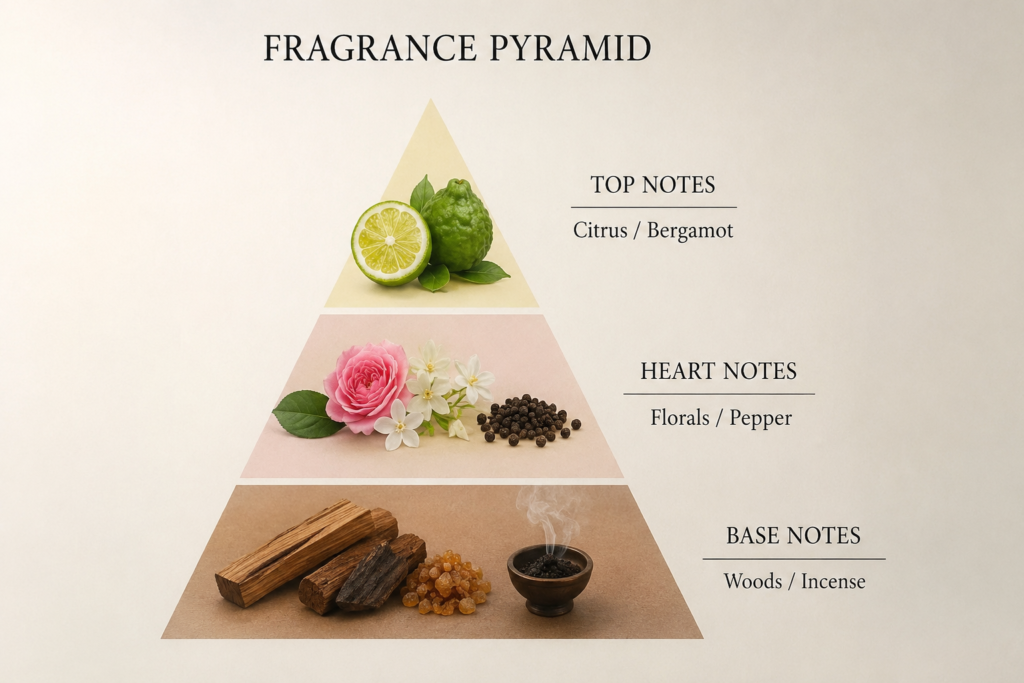
Every fragrance operates on a three-tier architecture known as the olfactory pyramid. Evolution occurs as the alcohol base evaporates:
Top Notes: The initial scent impact. Highly volatile molecules like bergamot, lemon, and green leaves that evaporate within 15–30 minutes.
Heart (Middle) Notes: The core theme. Medium-longevity molecules like rose, jasmine, and pink pepper that emerge as the top notes fade, lasting 2–4 hours.
Base Notes: The foundation. Heavy, dense molecules like cedarwood, sandalwood, frankincense, and musk that fix the scent to the skin, lasting 6–12+ hours.
Key Ingredients in Modern Formulations
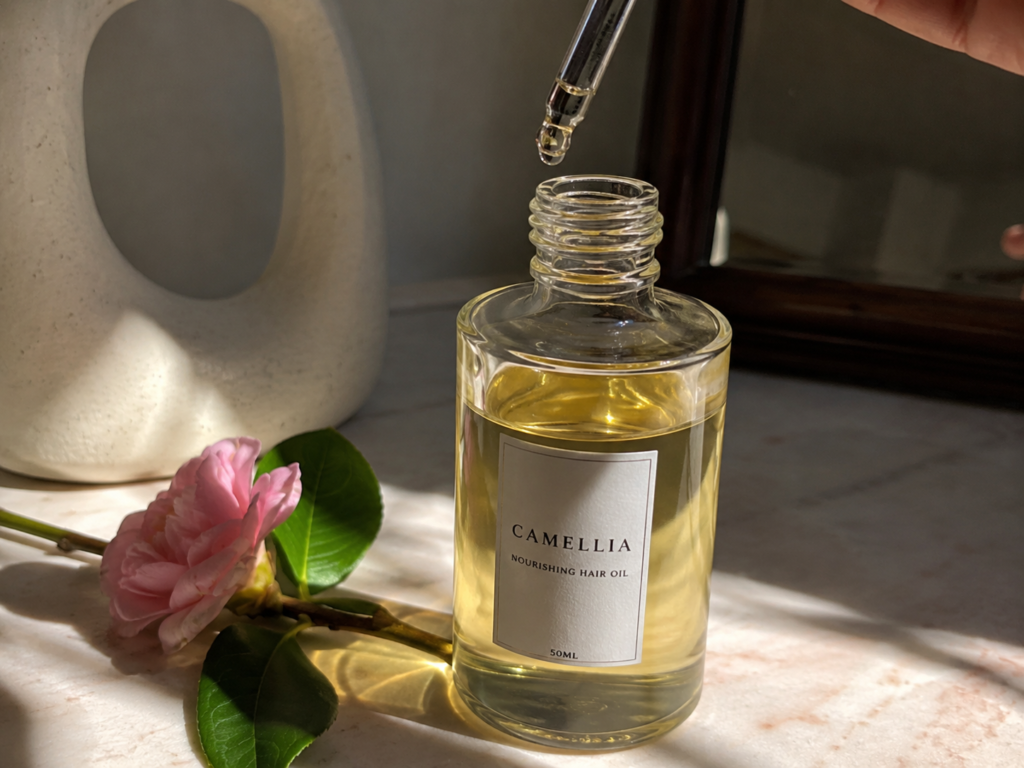
Camellia Oil for Hair: Derived from [Camellia japonica]( plants, this lightweight oil serves as an excellent natural fragrance carrier, trapping scent molecules on the hair shaft for sustained, slow-release diffusion.
Perfume With Bergamot Scent: Cold-pressed from the rind of Italian Citrus bergamia, bergamot acts as a universal brightener. It lifts heavy orientals and pairs seamlessly with woody structures.
Pink Pepper Fragrance: Harvested from the Schinus molle tree, this note adds a fresh, sparkling spice profile without the sharp heat of traditional black pepper.
Scent Families Worth Knowing
Woody Floral Perfume: The Season-Proof Classic
If there is a fragrance family that has deservedly become a modern wardrobe essential, it is the woody floral perfume. This kind of scent manages something that very few scent categories can do naturally: it combines softness with intensity, femininity with seriousness, and yet, it does so without going too far on either side.
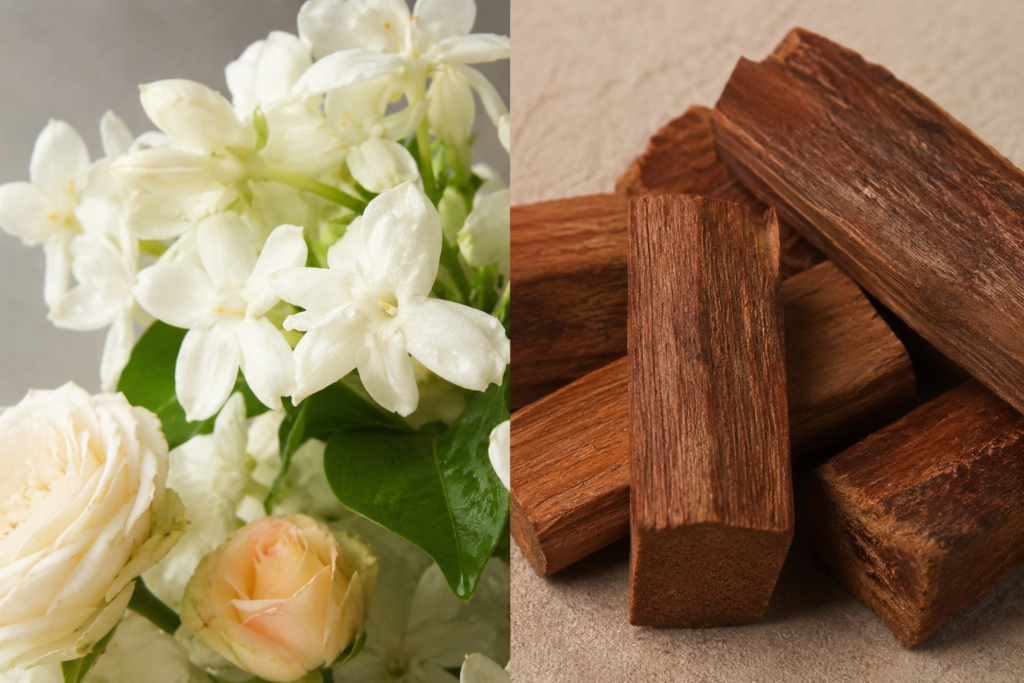
Usually, a great woody floral perfume will start with bright florals—like rose, jasmine, magnolia, or peony—and then develop into a comforting wood base of cedarwood, sandalwood, or vetiver. The change is what makes this family so enchanting; it is like a narrative on your skin that evolves with time
Who should reach for a woody floral:
Specifically, anyone who loves florals but finds pure florals too sweet or one-dimensional
Those who want a signature scent that works from a morning meeting to an evening out
Perfect for anyone drawn to quiet-luxury aesthetics and understated elegance
Incense Perfume: The Fragrance of Atmosphere
There are hardly any things in the world of fragrance that have as much cultural and emotional significance as incense perfume. Fragrance notes of incense, which come from old religious, spiritual, and meditation traditions, for example, Catholic churches or Japanese temples, give a feeling of ritual to which no other element can compare in modern perfumery.
The incense perfumes of today mainly utilise a variety of resins and woods. Olibanum (frankincense) has a dry, slightly zesty smoky scent. Myrrh is a mixture of sweet and bitter smells and quite a dark scent. Labdanum has an animal-like and resinous smell. Oud offers a remarkable depth and striking beauty that is capable of dividing the opinions of both lovers and haters of the fragrance world.
Incense fragrances excel in:
Cool weather and indoor autumn and winter environments
Evening events where a dramatic, long-lasting scent trail is the goal
Meditation, journaling, or any ritual that calls for an atmosphere
Powdery Scents: Soft, Nostalgic, and Thoroughly Modern
If incense perfume is a cathedral, powdery scents are a cashmere blanket. These compositions are built around ingredients like iris root, violet, heliotrope, and skin-close musks – notes that evoke warmth, intimacy, and the gentlest possible luxury.
The powdery family has been reclaimed by younger audiences in recent years. Far from feeling dated, modern powdery scents are lighter and more nuanced than their vintage counterparts. Iris-and-musk blends, in particular, feel entirely current — quiet, refined, and deeply personal in the way that quiet luxury fashion has trained us to appreciate.
The Ingredients Changing Modern Perfumery
Perfume With Bergamot Scent: The Brightest Note in the Kit
Ask any perfumer to name their most indispensable ingredient, and bergamot frequently tops the list. A perfume with bergamot scent opens with a luminous, citrus-green burst that is unlike any other note in the palette. Cold-pressed from the rind of the bergamot orange grown on Italy’s Calabrian coast, it is simultaneously citrusy, floral, and gently bitter.
Bergamot is the ingredient you already know – it is what gives Earl Grey tea its distinctive aromatic edge. In a perfume with bergamot scent, it functions as a master brightener, lifting everything around it without stealing the show. It pairs beautifully with florals, woods, ambers, and musks. It opens heavy orientals. It elevates clean aquatics. It is genuinely versatile in a way few other notes are.
Pink Pepper Fragrance: Spice Without the Sting
A pink pepper fragrance delivers a bright, rosy, and slightly fruity aroma that provides a vibrant, crisp energy to a perfume without the sharp, aggressive heat of traditional black pepper. Derived from the berries of the Schinus molle tree rather than a true pepper plant, this versatile note functions as an olfactory balancer in modern perfumery.
Technically, pink pepper scent comes from Schinus molle, a South American tree not related to culinary pepper. Perfumers prize it for its versatility. In a woody floral perfume, pink pepper acts as a brilliant bridge between the floral heart and the warm woody base – adding a fizziness that prevents the composition from feeling heavy.
What makes pink pepper such a modern favourite:
Pink pepper fragrance pairs equally well with feminine florals and masculine woods
Furthermore, this note adds warmth without sweetness – a rare and valuable quality
It blends beautifully with bergamot as an opening top-note duo
It reads as fresh in summer and gently spicy in autumn
Roll On Fragrance Oil and Camellia Oil: The Luxury Oil Ritual
Roll On Fragrance Oil: Redefining the Fragrance vs Perfume Experience with Precision
The roll-on fragrance oil has had a remarkable cultural renaissance. Once seen as a budget alternative to spray perfumes, it has been fully reclaimed by niche perfumers, clean beauty brands, and fragrance connoisseurs who appreciate its unique qualities.
A high-quality roll-on fragrance oil delivers concentrated aromatic compounds in a carrier oil base – often jojoba, argan, or camellia – directly to pulse points. The oil absorbs into the skin differently from alcohol-based sprays, creating a warmer, more intimate scent trail that unfolds slowly over the course of several hours.
Why roll-on is winning over a new generation of fragrance lovers:
Zero overspray – total control over application with no waste
Travel-friendly – compact enough to carry on any flight
Skin-compatible – the oil base is ideal for dry or sensitive skin
Sustainable – many formats are refillable and low-packaging
Layering-friendly – easy to apply multiple complementary accords in sequence
Camellia Oil for Hair: Where Perfumery Meets Beauty
One of the most elegant convergences of fragrance and beauty in the modern ritual is the use of camellia oil for hair. In Japanese beauty tradition, tsubaki oil – pressed from the seeds of the Camellia japonica flower – has been used for generations to give hair an extraordinary silk-mirror finish.
In contemporary fragrance culture, camellia oil for hair is increasingly valued as a fragrance carrier. Its completely neutral scent, ultra-lightweight texture, and deep conditioning properties make it the ideal base in oil-based perfumes and scented hair treatments. Several luxury perfume houses now incorporate camellia oil for hair into their scented hair mist lines – a category that is growing rapidly.
How to incorporate camellia oil into your fragrance ritual:
Apply a few drops of camellia oil for hair to the ends and mid-lengths before styling
Follow with a light roll of fragrance oil on the hair shaft for a slow-release scent diffusion
The oil seals in moisture and holds fragrance molecules beautifully
The result is glossy, conditioned hair that carries your chosen scent all day
Seasonal and Occasion Fragrance Guide
Wearing the right fragrance for the right moment is the most underrated styling skill in a beauty wardrobe. Here is a clean reference to guide your choices:
Occasion / Season
Best Scent Type
Key Notes to Look For
Spring morning
Light Woody Floral EDP
Bergamot, rose, cedar, green notes
Summer day out
Body Mist or Roll On
Pink pepper, citrus, aquatic musk
Autumn work week
Powdery EDP
Iris, violet, warm amber, sandalwood
Winter evening event
Incense Parfum or EDP
Frankincense, oud, myrrh, labdanum
Date night (any season)
Woody Floral Parfum
Rose, jasmine, vetiver, sandalwood
Travel / Long-haul flight
Roll On Fragrance Oil
Bergamot, clean musk, camellia carrier
Weekend brunch
Light EDT or Body Mist
Pink pepper, peony, neroli, white musk
The fragrance vs perfume conversation takes on a new dimension when you factor in the occasion. A heavy parfum at a casual brunch feels like wearing a ball gown to a coffee shop. The concentration should match the energy of the moment – present and appropriate, never overwhelming.
Common Fragrance Mistakes to Avoid
Even the most enthusiastic fragrance beginners fall into these traps. Recognising them early saves both money and disappointment.
Rubbing wrists together after application: When you do this, you’re literally crushing the fragile top notes, and they never get the chance to fully develop. Don’t rub your wrists together after applying.
Buying based on first spray: The opening scent isn’t everything. After 20-30 minutes, you can smell the heart notes and the true character comes out.
Testing too many fragrances at once: Our sense of smell becomes overloaded after three or four smells. Use coffee beans or your own skin, not paper strips, to reset.
Applying fragrance to dry skin: Aromatic molecules won’t stay put on dry skin. Either moisturise your skin or apply a roll-on fragrance first.
Frequently Asked Questions About Fragrance vs Perfume
What is the exact difference between fragrance and perfume?
The difference is categorization and concentration. Fragrance is a generic term for any scented material, including colognes, mists, and home sprays. Perfume is a specific retail category containing a high concentration of aromatic compounds (15% to 40% oil), yielding superior longevity.
Is a body mist really that different from a perfume?
Yes. Body mists are lightweight, water-based formulas containing 1% to 3% aromatic oils that last 1–2 hours. Perfumes are alcohol-based formulas containing 15% to 40% oil that last up to 12 hours. Mists are built for generous refreshing; perfumes are built for all-day wear.
What does a woody floral perfume smell like?
A woody floral perfume balances crisp floral middle notes (such as rose, jasmine, or peony) with dry, grounding base notes (like cedarwood, sandalwood, or vetiver). The resulting profile is clean, sophisticated, and gender-neutral.
Why is bergamot used in so many luxury perfumes?
Perfumers use bergamot because it works as an olfactory stabilizer and top-note enhancer. Its unique chemical makeup delivers a crisp citrus profile that is simultaneously floral and bitter, allowing it to brighten both fresh aquatics and heavy ambers.
What does pink pepper scent smell like?
Pink pepper scent is a vibrant, rosy, and mildly fruity spice profile. Unlike black pepper, it offers an effervescent warmth without aggressive nasal heat, making it an excellent bridge ingredient between bright top notes and heavy wood bases.
Conclusion: Wear It With Intention
Fragrance is the only element of your wardrobe that is entirely invisible and yet immediately recognisable. It is memory-triggering, mood-shifting, and deeply personal in ways that clothing, jewellery, and accessories rarely are. And now that you understand the difference between fragrance vs perfume, know when a roll on fragrance oil outperforms a spray, and can identify the ingredients that make a woody floral perfume or an incense perfume sing, your relationship with scent fundamentally changes.
The real skill is not in memorising concentration tiers or ingredient lists – it is in paying attention. The way a perfume with bergamot scent opens like sunlight. The way powdery scents settle into something that feels like a second skin by late afternoon. The way a pink pepper fragrance adds a vibrant spark to an otherwise quiet composition. These are not abstract details – they are the moments that make fragrance truly wearable art.
Start with samples. Wear them for full days before deciding. Layer slowly, rotate seasonally, and trust your instincts above all trend cycles. Browse our curated fragrance and modern lifestyle guides for deeper dives into seasonal scent styling, luxury beauty rituals, and the most exciting ingredient stories in contemporary perfumery.
Disclaimer: Fragrance formulations, ingredient concentrations, and product availability vary by brand and region. Skin chemistry significantly affects how a scent performs on an individual. Longevity claims are approximate. This article is for informational purposes only and does not constitute professional beauty advice.
I am Aayushi a passionate content writer specialized in creating SEO-optimized articles that rank well and reach the right audience. My approach combines deep research with an analytical mindset to ensure every piece is accurate and informative.
I specialize in breaking down complex or technical topics into reader-friendly content that truly resonates. By focusing on clarity and detail, I aim to provide our readers with valuable insights that educate, engage, and improve our online visibility.