
There are places in India where clothing isn’t just something you put on in the morning. In Himachal Pradesh, what people wear carries centuries of mountain culture, community identity, and handcraft skill that no factory can replicate. The wool is spun differently here. The patterns mean something specific. The Himachal Pradesh shawls draped over shoulders at a village fair or a winter wedding aren’t fashion choices — they’re cultural statements passed down through generations.
When we talk about traditional clothes of Himachal Pradesh, we’re looking at functional outerwear built for steep mountain slopes and freezing winds long before synthetic thermal wear existed.
If you’ve ever watched someone in a Kullu shawl walk through a crowded market and felt drawn to the colours and geometry of it, that pull is completely understandable. This is one of India’s most visually distinct textile traditions, and it’s worth understanding properly — not just as a tourist souvenir, but as a craft tradition that took centuries to develop.
Traditional Clothes of Himachal Pradesh: What Makes Them Unique?
Himachal Pradesh isn’t one uniform culture — it’s a collection of valleys, each with its own dialect, its own festivals, and its own textile identity. The traditional clothes of Himachal Pradesh reflect that diversity directly.
What someone wears in Kinnaur looks noticeably different from what’s worn in Kullu or Chamba, even though all three are within the same state.
The common thread across all regions is wool — and the reason is simple geography. At altitudes ranging from 350 metres to over 6,000 metres, warmth isn’t optional. The woollen textiles of Himachal Pradesh were designed for mountain winters first and cultural identity second, though over centuries both purposes became inseparable.
Handloom weaving, natural dyes, and intricate embroidery are the technical foundations of Himachali dress. The craftsmanship involved in a single authentic piece can represent weeks of work — which is why genuine Himachali textiles feel so noticeably different from machine-made approximations.
Himachal Pradesh Traditional Dress Name by Region
Understanding Himachal Pradesh traditional dress names requires looking at the state’s different regions rather than treating it as one category.
- Kullu District is home to the iconic Kullu shawl — bold geometric patterns in deep reds, greens, and blacks woven on handlooms by artisans who inherit the craft from their families. The Kullu cap, a small woollen topi with a turned-up brim, completes the look and is one of the most recognisable visual symbols of Himachali culture.
- Kinnaur District produces the Kinnauri shawl — distinguished by its green base with multicoloured geometric borders. The Kinnauri dress also includes the Pattu, a woollen wrap worn by women that functions as both clothing and warmth across the high-altitude valleys near the Tibetan border.
- Chamba District is celebrated for the Chamba Rumal — an embroidery tradition so refined that individual pieces are displayed in museums. The geometric and figurative embroidery on silk or cotton cloth represents some of the finest handcraft in all of North India.
Himachal Pradesh Shawls — The Crown of Himachali Textiles
If there’s one thing Himachal Pradesh is known for above all else in the world of Indian textiles, it’s the shawl. Himachal Pradesh shawls cover a range of types, qualities, and regional styles — but they share a handcrafted authenticity that separates them from mass-produced alternatives.
- Kullu Shawls are the most widely recognised — bold, geometric, and deeply colourful. Traditionally made from pure wool on pit looms, authentic Kullu shawls have a weight and texture that immediately distinguishes them from imitations. The patterns are regional and specific — village weavers maintain their own design vocabularies that carry community identity within them.
- Kinnauri Shawls carry a different aesthetic — finer weave, more restrained colour palette, often incorporating pashmina or angora alongside wool. The green-dominant border patterns are immediately recognisable and have earned Kinnauri textiles international buyers and recognition.
- Pashmina from Spiti — The high-altitude regions of Lahaul–Spiti are associated with premium pashmina wool sourced from Himalayan goats, making these shawls highly valued for their warmth and softness.
| Type | Material | Defining Feature |
| Kullu Shawl | Sheep or Merino wool | Plain background with bright, geometric border patterns |
| Kinnauri Shawl | High-grade wool | Intricate, Central Asian-style patterns covering the whole piece |
| Pashmina Shawl | Mountain goat wool | Featherweight feel with high thermal insulation |
When buying a genuine Himachal Pradesh shawl, look for the GI (Geographical Indication) tag on Kullu shawls, which guarantees handloom production and regional authenticity. Machine-made imitations are widely available — the GI tag is the most reliable way to distinguish an authentic piece.
Himachal Pradesh Traditional Dress Name for Men and Women
If you’re searching online for a specific Himachal Pradesh traditional dress name, it helps to know that men and women wear completely different setups across regions.
What Women Wear: Luanchari, Pattoo, and Dhatu
Women in the hills need clothes that keep them warm while carrying firewood, harvesting crops, or walking miles up steep trails.
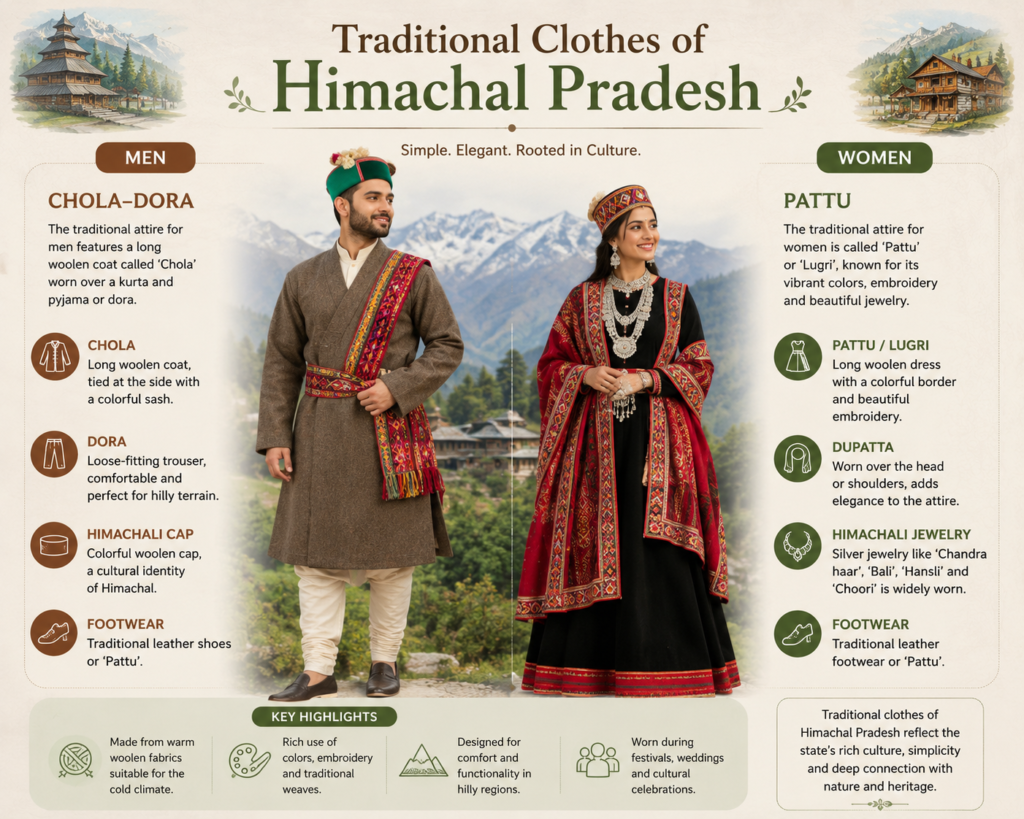
- Luanchari: In Kangra and Chamba, women wear this long, flowing garment. It’s essentially a wide skirt stitched to a fitted top, requiring up to 20 meters of fabric. When women rotate during traditional Nati dances, the skirt flares out wide like an open umbrella.
- Pattoo: Go toward Kullu or Mandi, and you’ll spot women wrapped in a Pattoo. It looks like a thick woolen blanket, but it’s draped around the torso and pinned tightly over both shoulders using silver pins called Boomani. It keeps your core warm even when snow starts falling.
- Dhatu: This is the printed square scarf tied around the head. Beyond keeping dust and harsh wind out of your hair, it’s an everyday staple across almost every Pahari household.
What Men Wear: The Classic Himachal Pradesh Men Dress
The typical Himachal Pradesh men dress is all about utility and ease of movement.
- Chola and Dora: Gaddi shepherds spend months moving livestock across high mountain passes. Their outfit centers on the Chola—a long, heavy woolen coat that hangs down past the knees. They tie it at the waist using a thick black wool rope called a Dora. The extra fabric bunched up above the rope forms a huge, makeshift pouch. Shepherds use it to carry dry food, pocket knives, or even newborn lambs on long walks.
- Suthan: These are tight woolen trousers worn underneath the coat to prevent cold air from rushing up the legs.
- Himachali Topi: This round woolen cap is worn by almost every man in the state. The front band features velvet in dark green, maroon, or red, giving an instant pop of color to an otherwise plain outfit.
How to Style Himachali Pieces in Modern Outfits
You don’t need to live in a chilly mountain town to make these traditional pieces work for you. Here are three simple ways to style them right now:
- Drape a Kullu Shawl Over a Coat: Throw a bright geometric shawl over a plain trench coat or dark blazer. It breaks up dull winter neutrals instantly.
- Pair a Pahari Cap with Ethnic Wear: Men can wear a velvet-front Himachali Topi with a white kurta or a fitted Nehru jacket for winter weddings.
- Try Vintage Silver Brooches: Use heavy silver brooches or vintage pins on your modern cardigans, inspired by the Pahari Boomani pinning style.
Why Traditional Clothes of Himachal Pradesh Still Matter Today
The mistake most visitors make is buying a Himachali shawl as a memento and putting it in a drawer. These textiles deserve better than that. A genuine Kullu shawl is warm enough for a British winter. A Kinnauri shawl is refined enough for a formal dinner. A piece of Chamba embroidery is museum-quality craftsmanship that happens to be wearable.
Traditional clothes of Himachal Pradesh represent one of India’s most intact living craft traditions — where the weaver, the pattern, and the mountain geography are all still connected in a way that most textile traditions have lost. Buying authentic Himachali textiles directly from artisans or GI-certified sellers also helps preserve traditional weaving communities and supports local livelihoods.
FAQs
The traditional clothes of Himachal Pradesh include the Kullu shawl, Kinnauri Pattu, Chamba Rumal embroidery, Kullu topi, Chola coat, and Churidar with woollen Kurta. Each region has its own distinct textile identity — Kullu, Kinnaur, Chamba, and Lahaul-Spiti all produce noticeably different traditional garments.
The most recognised Himachal Pradesh traditional dress names are the Kullu shawl, Kinnauri Pattu, Kullu topi, and Chola. Women’s traditional dress centres on the Pattu worn with a Choli and silver jewellery. Men’s traditional dress features the Kullu topi, woollen Kurta or Chola, and a draped shawl.
Himachal Pradesh shawls most celebrated internationally are the Kullu shawl (bold geometric patterns, GI tagged), Kinnauri shawl (fine weave with green-dominant borders), and Spiti pashmina (among the finest and softest wool available in India). Each carries a distinct regional identity and is produced by handloom weavers in their home districts.
Himachal Pradesh men’s dress traditionally includes the Kullu topi, a woollen Kurta or Chola coat, Churidar or straight-cut pyjama, and a draped Kullu shawl. In border regions like Kinnaur and Lahaul-Spiti, the Chola — a long woollen coat tied with a woven belt — reflects the Tibetan cultural influence of the high-altitude valleys.
A Kullu shawl is a handwoven woollen shawl produced in the Kullu Valley of Himachal Pradesh, characterised by bold geometric patterns in deep reds, greens, and blacks. It holds a GI (Geographical Indication) tag guaranteeing handloom production and regional authenticity. Kinnauri shawls are finer and more restrained in palette. Spiti pashmina is softer and more lightweight. The Kullu shawl is the most widely recognised of all Himachal Pradesh shawls.
Chamba Rumal is a traditional embroidery craft from the Chamba district of Himachal Pradesh, worked on silk or cotton cloth using double-satin stitch embroidery with no knots on either side. Individual pieces depict scenes from Hindu mythology and are considered some of the finest textile art in North India — with significant pieces displayed in national and international museum collections.
Authentic Himachal Pradesh shawls are available at the Himachal Emporium in Shimla, directly from weavers in Kullu and Rampur, at the Kullu Dussehra fair which features artisan stalls from across the state, and through GI-certified online sellers. Always look for the GI tag on Kullu shawls — it is the most reliable guarantee of handloom production and regional authenticity.
The Kullu topi is a small woollen cap with a turned-up brim worn by men across most of Himachal Pradesh. It carries deep cultural significance — worn at festivals, weddings, and official occasions as a marker of Himachali identity. Older generations wear it daily, and its pattern and colour can sometimes identify the wearer’s home district or community within the state.